How to Prioritize AI Use Cases for Integration

Artificial Intelligence has moved from a “future technology” to a core driver of competitive advantage. From predicting supply chain disruptions to automating insurance claims processing, AI use cases are expanding across every sector. The challenge for leaders is no longer whether to integrate AI, but which AI projects to start with.
Too many organizations fall into the “AI hype trap”, choosing flashy projects that look innovative but fail to deliver measurable business value. The result is wasted investment and delayed results. According to reports, 85% of AI projects fail to meet expectations because they lack strategic alignment and a clear prioritization framework.
Why Prioritization Matters in AI Integration
Choosing AI projects without a clear prioritization process risks:
- Resource waste – investing in complex projects that are hard to scale
- Slow adoption – requiring major infrastructure or culture shifts before value appears
- Compliance pitfalls – overlooking governance, bias, and regulatory obligations
On the flip side, getting it right has a huge upside. McKinsey reports that companies aligning AI projects with corporate strategy achieve up to 3x higher ROI.
For example, a retail chain prioritizing AI-driven demand forecasting can see immediate gains in stock availability and reduced wastage. A competitor chasing experimental generative AI ad tools may still be waiting for results a year later.
Step-by-Step AI Use Case Prioritization Framework
1. Align With Strategic Goals
The foundation of any AI prioritization effort is strategic alignment. Before you consider technical feasibility or budget, you must determine whether the AI initiative directly supports your organization’s top-level business objectives. AI adoption without a clear link to measurable goals often results in impressive prototypes that never make it to production or fail to gain stakeholder buy-in.
To test alignment, ask these key questions:
- Drive revenue growth: for example, can it help upsell to existing customers, expand into new markets, or introduce higher-margin offerings?
- Improve efficiency or reduce costs: Could it streamline operational processes, reduce manual effort, or cut waste in resource use?
- Enhance compliance or reduce risk: Does it help you meet regulatory requirements, strengthen security, or prevent costly errors?
- Improve customer satisfaction: Can it speed up service delivery, increase personalization, or improve overall customer experience metrics?
When an AI project ticks multiple boxes in this list, it should naturally rise to the top of your consideration set. Projects that fail to support at least one major strategic goal are strong candidates for deprioritization, no matter how innovative they may seem.
2. Identify Potential AI Use Cases
Once your AI strategy is linked to clear business goals, the next step is to compile a well-rounded list of potential use cases. Go beyond casual brainstorming by conducting a structured review that includes internal pain points, customer journey gaps, and competitive benchmarks.
- Internally, focus on bottlenecks, repetitive manual tasks, and processes that consume high-value staff time, these areas often yield quick wins for automation and efficiency gains.
- Externally, assess the customer experience to pinpoint delays, miscommunication, or poor personalization, and study how industry leaders deploy AI to set performance benchmarks or uncover differentiation opportunities.
This approach ensures you capture both obvious and less visible possibilities, creating a long list of use cases that can be refined later based on impact and feasibility.
Cross-industry examples illustrate this process in action:
| Industry | AI Use Case 1 | AI Use Case 2 |
|---|---|---|
| Insurance | Fraud detection models to identify suspicious claims in real time | Automated underwriting to accelerate policy approval |
| Retail | Inventory forecasting to ensure optimal stock levels | Personalized pricing engines to maximize margin while improving customer loyalty |
| Healthcare | Predictive diagnostics to identify disease risks earlier | Patient risk scoring to allocate resources more efficiently |
| Logistics | Route optimization to reduce fuel costs and delivery times | Automated load planning to improve capacity utilization |
3. Score Business Impact
Not all AI projects carry equal weight when it comes to business value. Hence, applying a consistent scoring framework is critical, it removes personal bias and ensures every potential use case is evaluated against the same set of criteria.
A practical approach is to score each use case on a 1-5 scale for four key dimensions:
- Revenue Potential – The ability to directly increase sales, open new revenue streams, or improve pricing power.
- Cost Savings – The potential to reduce operational expenses, eliminate inefficiencies, or lower labor costs.
- Customer Experience Improvement (CX) – The capacity to improve satisfaction, retention, or Net Promoter Score (NPS) through better service, personalization, or speed.
- Risk Reduction – The ability to reduce compliance violations, fraud, operational errors, or other threats to business continuity.
When each dimension is scored, you can sum the numbers to get a Total Business Impact Score.
Example Scoring Table:
| Use Case | Revenue Impact | Cost Savings | CX Impact | Risk Reduction | Total Score |
|---|---|---|---|---|---|
| AI Claims Triage | 5 | 4 | 5 | 3 | 17 |
| Predictive Maintenance | 4 | 5 | 3 | 4 | 16 |
| Gen AI Marketing Copy | 2 | 2 | 3 | 1 | 8 |
Projects with strong scores across multiple categories should move forward faster, while low-scoring ideas may need rethinking, refinement, or removal from your priority list.
4. Score Feasibility
A high-impact AI project is only valuable if it can be implemented within a realistic timeframe. Evaluating feasibility alongside impact helps avoid stalled initiatives and wasted investment.
Key factors to assess:
- Data Readiness – Is relevant, clean, and sufficient data already available?
- Technical Complexity – Is the required technology proven, or will it require heavy custom development?
- Integration Effort – Can it connect with current systems without major rework?
- Time to Value – Can it deliver measurable results within months rather than years?
A telecom with clean subscriber data can deploy churn prediction quickly. For a government agency with fragmented, outdated systems, the same project might require years of preparation. By scoring feasibility early, you can focus on projects that can deliver results now and defer those that require significant foundational work.
5. Evaluate Compliance & Risk
AI projects often involve sensitive or regulated data, so governance must be part of the prioritization process, not an afterthought.
When reviewing compliance readiness, focus on:
- Privacy Laws – Does your use case comply with data protection regulations such as GDPR in Europe, HIPAA in healthcare, or CCPA in California? These laws dictate how data can be collected, stored, and used.
- Industry-Specific Regulations – Each sector has its own compliance landscape. For example, financial services must meet anti-money laundering (AML) rules, while transportation might face safety and reporting mandates.
- Ethical AI Considerations – Beyond legal compliance, ensure the model is explainable, transparent, and free from bias that could lead to unfair decisions.
Addressing these requirements upfront allows you to avoid costly delays, protect your brand, and build trust with both customers and regulators.
6. Map to an Impact vs Feasibility Matrix
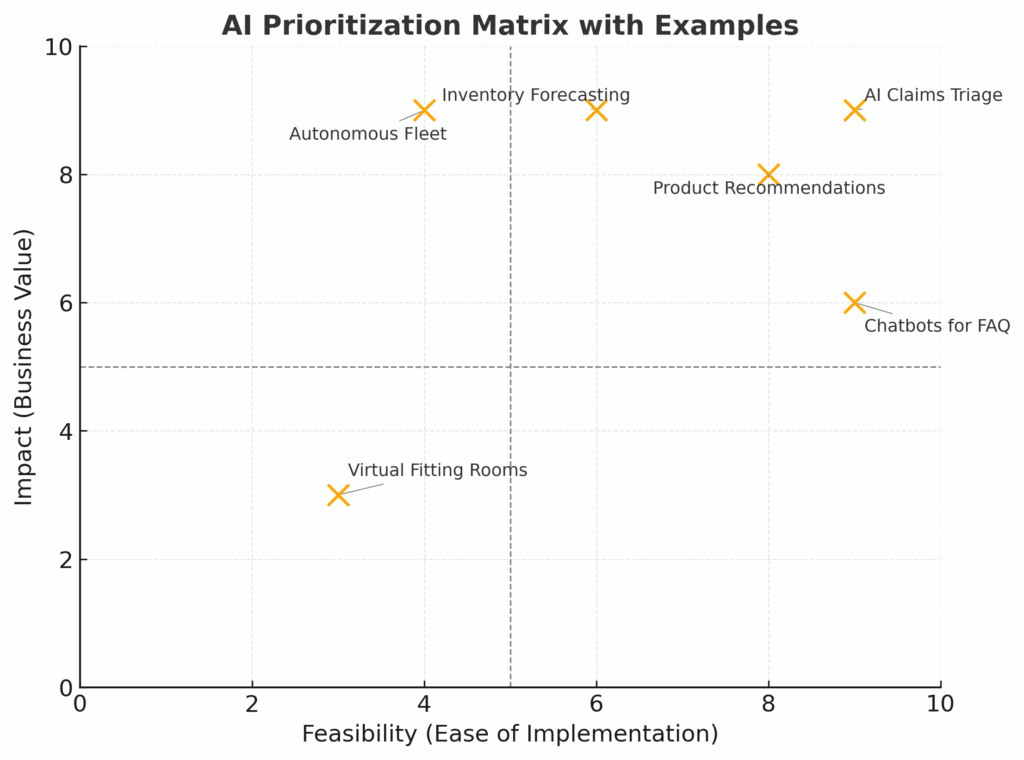
Once each AI use case has been scored for business impact and feasibility, the next step is to visualize the results on a two-axis chart. This matrix helps turn abstract numbers into a clear, strategic picture of where to focus your efforts first.
On the X-axis, you plot feasibility: how practical it is to implement the project now. On the Y-axis, you plot impact: how much measurable value it will deliver to the business.
When plotted, each project will fall into one of four quadrants:
- Top-right quadrant → High impact + high feasibility
These are your priority projects. They can be executed relatively quickly and are likely to produce significant ROI - Bottom-right quadrant → – Lower Impact + High Feasibility
These are your quick wins. While they might not transform the business, they can deliver visible improvements and help establish trust in AI across the organization. - Top-left quadrant → High Impact + Low Feasibility
They hold significant potential but require more data readiness, technology maturity, or organizational change before they can be executed successfully. - Bottom-left quadrant → Low Impact + Low Feasibility
They neither deliver meaningful value nor are easy to implement, making them poor candidates for immediate investment.
Example Visual:
7. Build a Phased Roadmap
AI adoption works best when projects are rolled out in stages, starting with quick wins, building essential capabilities, and then moving toward innovation and differentiation. An experienced AI consulting partner can help you design a phased roadmap that balances quick wins with long-term innovation goals.
- Phase 1: Quick Wins
Low-effort, high-ROI projects that can be deployed rapidly using existing tools and data. They deliver visible results fast, building trust and momentum for future AI initiatives. - Phase 2: Strategic Enablers
Core projects that establish the infrastructure, models, and processes needed for scaling AI. They may take longer to implement but are essential for enabling advanced capabilities. - Phase 3: Differentiators
High-impact projects that create a competitive edge by offering unique capabilities or customer experiences. They build on the foundation laid in earlier phases. - Phase 4: Exploratory R&D
High-risk, high-reward initiatives exploring emerging AI technologies. While long-term, they can position the organization as an innovator when the tech matures.
8. Review & Re-Prioritize Quarterly
AI strategies should never be a “set it and forget it” plan. The pace of AI innovation, combined with shifting market conditions and evolving internal capabilities, means that what’s a top priority today might not even make the list six months from now. Treating prioritization as a living process ensures that your AI investments stay relevant and deliver sustained value.
Industry-Specific AI Use Case Priorities
While the details vary, most industries approach AI in phases, fast wins first, foundational projects next, and bold innovations last.
| Industry | Phase 1 (Quick Wins) | Phase 2 (Strategic Enabler) | Phase 3 (Differentiator) |
|---|---|---|---|
| Insurance | Claims triage | Fraud detection | Dynamic pricing |
| E-commerce | Product recommendations | Inventory forecasting | Personalized pricing |
| Manufacturing | Predictive maintenance | Supply chain optimization | Autonomous quality control |
| Healthcare | Medical image analysis | Predictive patient monitoring | Personalized treatment |
| Banking | Automated KYC | Fraud detection | AI credit scoring |
| Logistics | Route optimization | Demand forecasting | Autonomous fleet |
| Telecom | Churn prediction | Network optimization | AI-driven customer offers |
| Energy | Predictive grid maintenance | Load forecasting | Smart pricing models |
| Real Estate | Automated property valuation | Market trend analysis | Predictive investment models |
| Education | Automated grading | Adaptive learning | AI-driven curriculum design |
Common Pitfalls to Avoid
- Starting with complex, low-readiness projects that stall before delivering ROI.
- Overlooking data governance and ethical AI safeguards.
- Underestimating training and change management requirements.
- Choosing projects for “cool factor” instead of business value.
- Attempting multiple large AI rollouts without a phased approach.
- Failing to involve cross-functional teams early in the process.
- Not tracking ROI and performance after deployment.
- Relying too heavily on vendor promises without due diligence.
Conclusion
Prioritizing AI use cases is less about volume and more about focus, selecting initiatives with clear strategic alignment, measurable business impact, and realistic timelines. The most successful organizations sequence their projects to deliver quick wins first, then build toward more complex, high-value capabilities.
At Samarpan Infotech, we help businesses make these decisions with confidence. Our AI integration services combine strategic planning, impact assessment, and technical execution to ensure your AI roadmap delivers value at every stage, whether you need immediate automation wins, scalable AI foundations, or differentiators that set you apart in the market.
With over 10 years of experience in Tech industry at Samarpan Infotech with architect system, problem solving and creativity. "Today is the only day. Yesterday is gone".