How AI Integration Is Reshaping Financial Services

If you work in finance sector today, you’re feeling the shift. Customer expectations are accelerating, regulatory examination is getting stricter, and manual processes can’t keep up with real‑time demands. The solution isn’t just digitization, it’s intelligent automation.
Artificial Intelligence (AI) is no longer experimental. It’s the silent force behind faster claims, fairer risk models, and frictionless customer journeys. In fact, over 78% of financial institutions globally have already integrated at least one AI‑based function.
8 Key Areas for AI Automation in Financial Services
1. Automation of Manual Processes
As financial institutions face pressure to deliver faster services and meet evolving compliance demands, manual workflows have become a major constraint.
Tasks like customer onboarding, document verification, transaction processing, or account setup are still driven by repetitive, human-dependent steps. This slows response times, increases error rates, and limits scalability, whether you’re a bank, insurer, lender, or asset manager.
How AI Automation Can Be Implemented
- Identify High-Volume, Repetitive Tasks: Target workflows such as loan processing, claims intake, KYC checks, data entry, or trade reconciliation.
- Digitize Inputs with OCR: Use Optical Character Recognition to extract structured data from scanned forms, statements, invoices, or handwritten submissions.
- Automate Workflow Steps with RPA: Deploy Robotic Process Automation to mimic user actions like populating forms, transferring data, or triggering backend updates.
- Add Intelligence with Machine Learning: Use ML models to flag inconsistencies, predict routing outcomes, or classify document types based on historical patterns.
- Ensure Oversight with Human-in-the-Loop Review: Introduce checkpoints and escalation paths for exceptions, risk reviews, and compliance verifications.
5 Benefits of AI Automation
- Faster Turnaround: Approvals, onboarding, and processing happen in minutes, not days.
- Lower Costs: Automation reduces manual effort and operating overhead.
- Higher Accuracy: AI minimizes human errors across forms and transactions.
- Easier Scaling: Workloads grow without needing to expand teams.
- Improved Auditability: Every action is logged and traceable for compliance.
2. Fraud Detection and Prevention
Fraud is a growing threat across financial services, from identity theft and account takeovers in banking, to false claims in insurance, loan stacking in lending, and phishing attacks in wealth platforms.
Traditional rule-based detection systems are slow, reactive, and often generate high false-positive rates. As fraud tactics evolve, manual reviews and static thresholds no longer offer sufficient protection.
How AI Automation Can Be Implemented
- Monitor Transaction Patterns in Real Time: Deploy ML models that analyze real-time activity across payments, logins, transfers, and claims to spot anomalies.
- Use Behavioral Biometrics: Track user behavior like typing speed, swipe patterns, or mouse movement to detect impersonation or bot activity.
- Apply NLP to Detect Suspicious Language: Use Natural Language Processing to analyze claim statements, emails, or chat transcripts for fraud cues and inconsistencies.
- Implement Anomaly Detection Models: Train unsupervised models to learn normal user behavior and flag deviations, even if no prior fraud labels exist.
- Integrate with Risk Management Platforms: Feed AI alerts into fraud case management or core systems for faster triage and automated escalation.
4 Benefits of AI in Fraud Prevention
- Real-Time Detection: Flags fraud as it happens, not after damage is done.
- Lower False Positives: Smarter models reduce unnecessary alerts and customer friction.
- Scalable Monitoring: Continuously watches thousands of accounts or transactions without added staff.
- Adaptive Defense: AI learns from emerging patterns and adapts over time.
3. Personalized Customer Experiences
Financial customers today expect more than transactional service, they want experiences tailored to their needs, preferences, and behavior. Whether it’s a banking customer applying for a loan, a policyholder seeking support, or an investor reviewing their portfolio, generic interactions fall short.
Traditional systems struggle to scale personalization, often relying on static rules or outdated segmentation. The result? Missed opportunities, inconsistent service, and customer churn.
How AI Automation Can Be Implemented
- Deploy Conversational AI Assistants: Use AI-powered chatbots and voice agents to answer questions, guide users, and complete tasks across web, mobile, or IVR.
- Leverage Predictive Analytics: Analyze past behavior, product usage, and interaction history to recommend next-best actions or offers.
- Use Dynamic Segmentation Models: Group customers by real-time behavior or lifecycle stage, not just demographics, to deliver targeted messaging and journeys.
- Apply LLM and Sentiment Analysis: Detect tone, urgency, and intent from customer interactions to prioritize high-impact responses or flag issues before escalation.
- Unify Data Across Channels: Connect customer data from CRM, call centers, apps, and websites to create a consistent, cross-channel experience powered by AI.
5 Benefits of AI in Personalization
- Faster Support: Resolves common requests instantly through self-service.
- Higher Engagement: Tailored recommendations improve product uptake and usage.
- Improved Retention: Personalized touchpoints help build long-term loyalty.
- Smarter Cross-Selling: AI matches customers to relevant services or upgrades.
- Proactive Service: Flags customer needs before they even reach out.
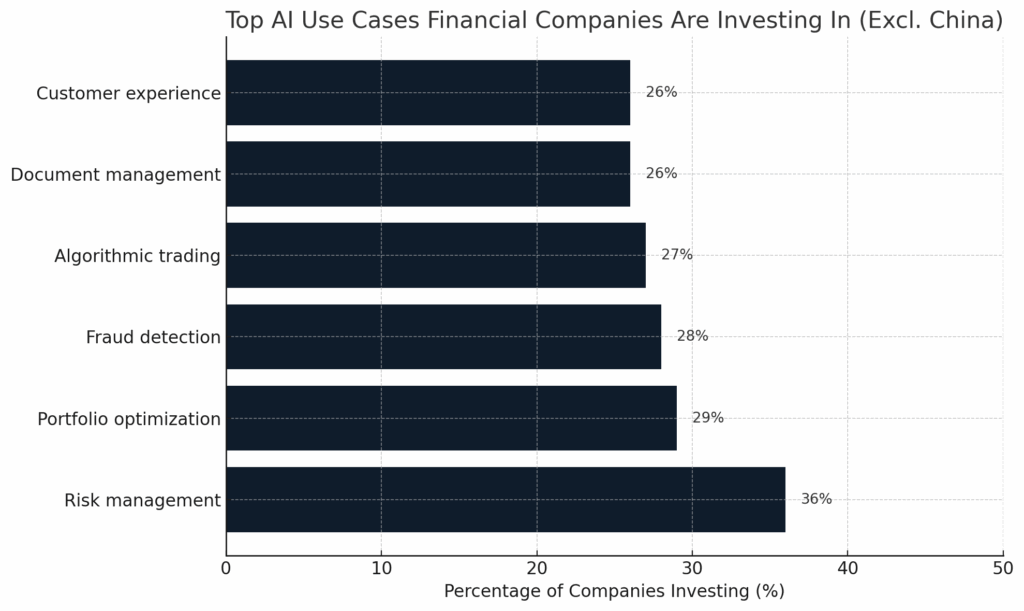
4. Risk Assessment and Underwriting
Risk evaluation is central to nearly every financial decision, approving a mortgage, underwriting a policy, pricing a loan, or managing an investment. Traditionally, these decisions relied on static models, historical averages, and siloed data.
Manual risk assessments often miss context, fail to adapt in real time, and introduce bias or inconsistency. As markets, behaviors, and data sources evolve rapidly, traditional underwriting approaches struggle to keep up.
How AI Automation Can Be Implemented
- Ingest Alternative and Real-Time Data: Use AI to evaluate non-traditional data sources alongside conventional inputs.
- Deploy Predictive Risk Models: Train machine learning models to assess default probability, claims likelihood, or investment risk using historical and behavioral data.
- Automate Rule-Based Risk Classification: Use AI to auto-classify risk profiles and route applications to the right workflow, instant approvals, manual reviews, or declines.
- Incorporate Explainable AI (XAI): Use explainable models to ensure transparency in AI-driven decisions, especially in regulated sectors like insurance, credit, and investments.
- Continuously Refine with Feedback Loops: Enable AI models to learn from outcomes (e.g., defaults, early surrenders, high-claim profiles) and improve accuracy over time.
4 Benefits of AI in Risk Assessment
- Faster Decisioning: Speeds up approvals and underwriting with real-time scoring.
- Improved Risk Accuracy: Assesses risk using more variables and deeper patterns.
- Fairer Outcomes: Reduces bias by relying on data-driven models over static rules.
- Scalable Risk Operations: Handles more applications or portfolios without adding underwriters.
5. Regulatory Compliance and Audit Readiness
Compliance is one of the most resource-intensive areas in financial services. Institutions must navigate a growing web of regulations, each requiring timely reporting, strict data controls, and full audit trails.
Manual compliance processes are costly, error-prone, and difficult to scale. Worse, they often become a bottleneck during audits, regulatory reviews, or incident investigations.
How AI Automation Can Be Implemented
- Automate Data Collection and Validation: Use AI to extract and verify compliance-relevant data from documents, forms, transactions, or logs across systems.
- Apply LLM for Policy and Communication Monitoring: Scan internal emails, chat logs, contracts, and call transcripts for regulatory violations or risky language patterns.
- Use ML for AML/KYC Screening: Enhance anti-money laundering checks and identity verification with AI models trained to detect suspicious behavior and identity mismatches.
- Generate Real-Time Compliance Reports: Automate report creation for regulators by feeding structured data into dashboards or filing templates with pre-validated logic.
- Enable Audit-Ready Logging and Traceability: Log every AI-driven decision, flag, or data pull with full timestamps and justifications, critical for audit and legal reviews.
5 Benefits of AI in Compliance and Audit
- Faster Reporting: Reduces time spent gathering and formatting regulatory data.
- Lower Compliance Costs: Automates routine monitoring and documentation tasks.
- Reduced Regulatory Risk: Flags issues early, reducing the risk of fines or sanctions.
- Improved Accuracy: Minimizes manual data entry errors in reports and filings.
- Continuous Monitoring: AI runs 24/7 to catch violations in real time.
6. Customer Retention and Churn Prediction
Retaining customers is often more profitable than acquiring new ones, yet many financial institutions still lack proactive strategies to detect and address churn risk. Whether it’s a banking client quietly reducing account activity, an insurance policyholder nearing non-renewal, or a wealth client transferring assets elsewhere, traditional systems typically identify churn after it happens.
How AI Automation Can Be Implemented
- Track Behavioral Indicators Across Channels: Use AI to monitor digital interactions, usage frequency, transaction history, or missed payments for early warning signals.
- Build Churn Prediction Models: Train ML algorithms to detect patterns associated with customer disengagement, cancellations, or reduced product usage.
- Score and Segment Customers by Risk: Assign churn risk scores and dynamically group users by urgency level to prioritize retention actions.
- Trigger Personalized Retention Campaigns: Integrate AI models with marketing tools or CRM systems to launch targeted offers, messages, or service interventions automatically.
- Incorporate Feedback for Model Improvement: Refine predictions continuously by feeding in churn outcomes, customer responses, and retention results.
5 Benefits of AI in Retention and Churn Reduction
- Early Warning Signals: Identifies disengagement before customers leave.
- Higher Retention Rates: Enables proactive, personalized outreach at scale.
- More Targeted Interventions: Focuses efforts on the highest-risk segments.
- Better Customer Insights: Uncovers root causes of dissatisfaction or disengagement.
- Reduced Revenue Leakage: Protects long-term value from existing clients.
7. Portfolio and Wealth Management Optimization
Financial advisors often rely on manual research, generic risk profiling, or static rebalancing rules that don’t reflect real-time conditions.
This limits personalization, delays decision-making, and can lead to missed opportunities for both clients and firms. As portfolios diversify across asset classes and client needs evolve, the demand for smarter, faster, and more adaptive wealth management continues to grow.
How AI Automation Can Be Implemented
- Automate Portfolio Rebalancing: Use AI to monitor drift from target allocations and automatically trigger rebalancing actions based on client goals and market movement.
- Apply Predictive Analytics for Investment Insights: Leverage machine learning to forecast market trends, assess asset correlations, or flag potential underperformance.
- Use NLP to Process Market Sentiment: Analyze news, analyst reports, earnings calls, and social signals to gauge market sentiment and adjust strategy accordingly.
- Enhance Client Profiling with Behavioral Data: Build dynamic investor personas using real-time behavior, preferences, and engagement patterns to drive tailored recommendations.
- Integrate with Advisory Platforms and Robo-Advisors: Embed AI models into client portals or advisor dashboards for real-time insights, nudges, and strategy simulations.
5 Benefits of AI in Portfolio Optimization
- Deeper Investment Insights: Surfaces trends and correlations that static models often miss.
- Personalized Client Experience: Tailors strategies to individual risk tolerance and goals.
- Improved Risk Management: Anticipates volatility using predictive and sentiment data.
- Higher Operational Efficiency: Automates research and rebalancing at scale.
- Greater Advisor Productivity: Frees up time for client relationships and strategic planning.
8. Dynamic Pricing and Product Innovation
Financial products have traditionally been priced using rigid, rule-based models, annual premiums, fixed loan rates, flat fees. But as customer behavior, risk exposure, and economic conditions evolve rapidly, static pricing can lead to lost revenue, under- or overexposure to risk, and poor product fit.
Manual pricing updates are slow and rarely reflect real-time market dynamics or individual client signals. Innovation suffers when products can’t adapt to what customers actually need or how they behave.
How AI Automation Can Be Implemented
- Enable Real-Time Data Feeds into Pricing Engines: Use AI to ingest live behavioral, usage, market, or environmental data into pricing models for up-to-date decisions.
- Train Machine Learning Models for Risk-Based Pricing: Apply ML to understand risk drivers at the individual level, like telematics for driving behavior, or transaction history for credit risk.
- Segment and Personalize Offers Dynamically: Use clustering algorithms to identify high-potential segments and deliver targeted pricing or product configurations instantly.
- Simulate and Optimize Scenarios: Run AI-powered simulations to test pricing strategies against demand elasticity, margin thresholds, or regulatory limits.
- Support Usage-Based and On-Demand Models: Leverage AI to monitor usage patterns in real-time and dynamically calculate pricing, especially in insurance (UBI), credit lines, or robo-advisory fees.
5 Benefits of AI in Pricing and Product Innovation
- More Accurate Pricing: Reflects real-time risk and behavior, not just averages.
- Higher Profit Margins: Aligns price with true customer value and risk.
- Greater Product Flexibility: Supports modular, on-demand, or tiered offerings.
- Faster Speed to Market: Reduces time to test and launch new product ideas.
- Improved Customer Fit: Matches pricing and features to actual needs and usage.
Top 6 Financial Sectors Benefiting Most from AI Integration
1. Insurance (P&C, Life, Health, MGAs)
Why it benefits most:
From processing claims and underwriting policies to detecting fraud and pricing risk, insurers handle vast volumes of structured and unstructured data daily. AI enables faster decisions, reduces manual intervention, and improves accuracy across the policy lifecycle.
McKinsey estimates AI can improve claims processing by up to 3-5% in insurance.
5 High-impact AI use cases:
- Automated claims processing (OCR + image recognition)
- Fraud detection through pattern analysis
- Predictive underwriting using alternative data
- Chatbots for 24/7 policyholder support
- Dynamic pricing (e.g., usage-based auto insurance)
2. Retail & Commercial Banking
Why it benefits most:
Banks deal with massive transactional volumes, customer interactions, and compliance obligations. AI helps banks process this data in real time, personalize customer experiences, and maintain security and compliance at scale.
According to Deloitte survey, 86% of financial services AI adopters say that AI will be very or critically important to their business’s success in the next two years.
5 High-impact AI use cases:
- AI-powered credit scoring and loan approvals
- Personal finance assistants and chatbot banking
- Real-time fraud detection on digital payments
- Document and identity verification for onboarding (eKYC)
- AML compliance automation
3. Fintech & Digital Lending Platforms
Why it benefits most:
Agility is key in fintech. AI allows fintechs to scale operations, approve loans quickly, and personalize offerings. By using alternative data and real‑time models, fintechs can underwrite, price, and approve loans in minutes, personalize product offers, and serve thin‑file or underbanked customers profitably.
5 High-impact AI use cases:
- Instant credit scoring using alternative data (e.g., mobile usage, utility bills)
- Personalized lending offers
- Risk-based pricing on microloans
- Real-time fraud flagging
4. Wealth Management & Asset Management
Why it benefits most:
Traditional portfolio management systems struggle to deliver at scale. AI enables real-time rebalancing, sentiment-driven strategy shifts, and tailored recommendations across multiple accounts. This helps firms deliver both precision and personalization without increasing advisor workloads.
5 High-impact AI use cases:
- Robo-advisors with real-time rebalancing
- Sentiment analysis on news & earnings reports
- Portfolio risk alerts and smart reallocation
- Client segmentation and behavioral profiling
5. Corporate & Investment Banking
Why it benefits most:
In corporate and investment banking, AI helps automate deal analysis, model credit and counterparty risk, and power algorithmic trading strategies that react in milliseconds. This allows institutions to navigate uncertainty while optimizing performance and compliance in real time.
5 High-impact AI use cases:
- Algorithmic trading using AI models
- AI-generated deal or risk analysis
- Natural Language Processing to extract insights from filings or financial statements
- KYC/CDD automation for institutional onboarding
6. RegTech & Compliance Departments (Cross-sector)
Why it benefits most:
Manual checks are time-consuming, inconsistent, and costly. AI streamlines these processes by automating data validation, identifying anomalies, and generating audit-ready logs, helping institutions stay compliant while reducing overhead and human error.
5 High-impact AI use cases:
- Automated regulatory reporting
- NLP for monitoring internal communications
- Real-time AML surveillance
- Explainable AI for regulatory transparency
6 AI Implementation Challenges in Financial Services
Despite its potential, AI adoption in financial services isn’t without roadblocks. Many firms face a mix of technical, regulatory, and organizational challenges that can stall or limit impact.
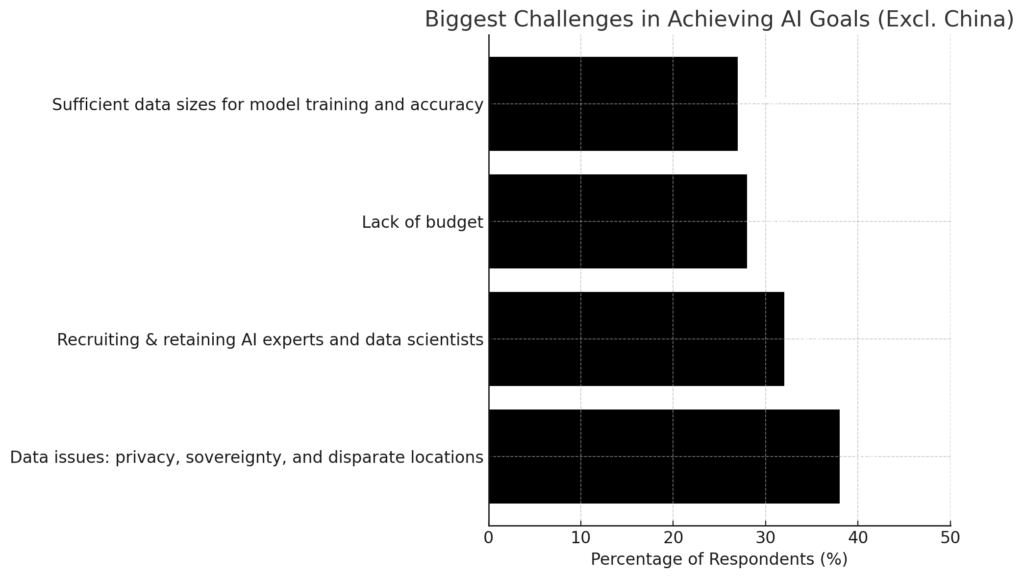
- Data Silos and Quality Issues: AI need clean, unified data, but many financial institutions still rely on fragmented, legacy systems.
- Regulatory and Ethical Constraints: AI decisions must be explainable and compliant. “Black box” models risk regulatory pushback, especially in credit, claims, and fraud use cases.
- Skills and Talent Gaps: Most firms lack in-house expertise to develop, deploy, and govern AI models effectively.
- Integration Complexity: Legacy core systems don’t always play well with AI tools, slowing implementation and increasing costs.
- Ongoing Model Maintenance: AI models require constant monitoring, retraining, and governance to stay accurate and unbiased over time.
To succeed, financial firms must treat AI adoption as both a technology investment and a strategic change initiative, backed by data readiness, compliance alignment, and cross-functional buy-in.
5 Ways for Adopting AI in Financial Services
For banks, insurers, fintechs, and wealth firms, AI adoption is no longer optional, but success depends on more than just technology. Here’s how to do it right:
- Start with High-Impact Use Cases: Focus on areas like claims, fraud, credit scoring, or onboarding where AI delivers both efficiency and compliance value.
- Get Your Data in Order: Unify data across systems (PAS, CRM, LOS, etc.), clean it, and apply governance to enable trusted AI insights.
- Build with Compliance in Mind: Use explainable models and keep audit trails, essential for meeting regulations in lending, underwriting, or KYC.
- Pilot in a Sandbox: Test models on real workflows before rollout. Validate fairness, performance, and downstream risk.
- Cross-Functional Teams Win: Bring together data, risk, ops, and compliance from day one to reduce resistance and ensure safe scaling.
Read Detailed Blog on: How to Prioritize AI Use Cases for Integration
Conclusion
AI is rapidly reshaping how financial institutions operate, from faster onboarding and smarter underwriting to real-time fraud detection and dynamic product pricing. But unlocking its full value requires more than tools. It demands clean data, regulatory alignment, and expert implementation.
That’s where Samarpan Infotech’s AI integration services come in. We help banks, insurers, fintechs, and investment firms deploy scalable, secure, and compliant AI solutions tailored to their business goals.
With over 10 years of experience in Tech industry at Samarpan Infotech with architect system, problem solving and creativity. "Today is the only day. Yesterday is gone".