How AI Integration Can Help Small to Mid-Size Businesses Scale Operations
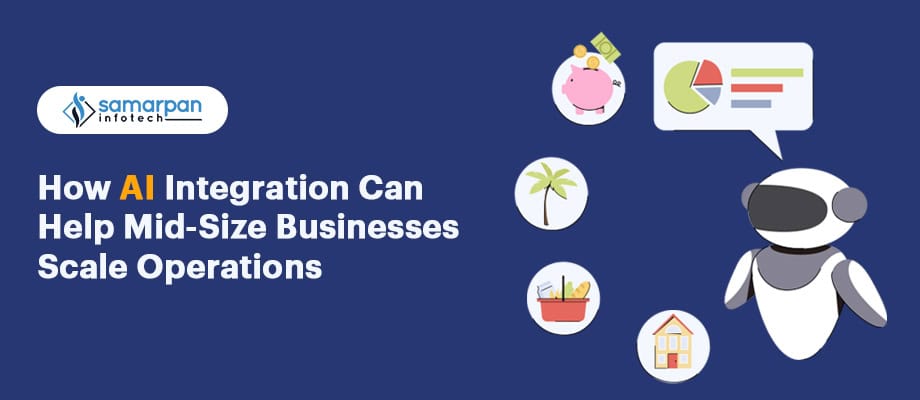

Mid-sized companies are the backbone of the global economy, agile enough to move quickly but often lacking the resources of large enterprises. The challenge? Scaling operations without scaling headcount, risk, or complexity.
That’s where AI integration becomes a game-changer.
Once reserved for tech giants, AI is now accessible to mid-size businesses through cloud platforms, no-code tools, and off-the-shelf APIs. And it’s not about replacing people, it’s about removing friction, unlocking insights, and automating what slows you down.
Why AI Matters for Small & Mid-Sized Businesses
AI adoption among SMBs is rising fast, and for good reason:
- McKinsey reports that 44% of mid-sized firms using AI saw a reduction in operational costs by 20-30%.
- Cloud-based tools (e.g., OpenAI, Amazon Bedrock, Azure Cognitive Services) make AI integration affordable.
- No-code/low-code platforms allow teams to deploy AI without hiring machine learning engineers.
In short, AI has shifted from futuristic to foundational. It now powers functions like customer support, demand forecasting, document processing, and sales enablement, across teams and tools you already use.
Core Areas Where AI Streamlines Business Operations
1. Workflow Automation
AI helps eliminate repetitive tasks, from HR forms to accounts payable.
- Invoice scanning with AI OCR extracts key data fields automatically, reducing manual entry and errors. This accelerates payment cycles by up to 80%, improving cash flow and vendor relations.
- Document classification and form parsing sort HR, legal, and operational paperwork into the right workflows. This reduces admin burden and ensures faster, compliant document handling.
- AI scheduling assistants coordinate meetings by analyzing calendars and resolving conflicts in real time. They eliminate back-and-forth emails and save teams hours per week.
2. Customer Experience & Support
AI doesn’t just automate, it communicates.
- Chatbots and voice assistants now resolve 60-70% of Tier 1 support queries around the clock. This reduces response times, lowers support costs, and improves customer satisfaction.
- AI-powered semantic search enhances self-service portals by understanding user intent, not just keywords. Customers find accurate answers faster, reducing ticket volume and frustration.
- Emotion analysis tools detect tone and sentiment in messages or calls in real time. They flag unhappy customers early, enabling faster human intervention and retention.
3. Data-Driven Decision Making
AI enables insights that static dashboards can’t deliver.
- Predictive analytics helps anticipate churn, forecast inventory, and adapt to seasonal demand shifts. This allows mid-size businesses to act proactively instead of reacting too late.
- Machine learning models uncover hidden trends in KPIs like revenue leakage, throughput, or downtime. These insights drive smarter operational decisions that humans might overlook.
- Decision intelligence platforms combine data from multiple sources to guide pricing, hiring, and budgeting. This reduces guesswork and improves strategic planning across departments.
4. Marketing & Sales Acceleration
AI amplifies every stage of the revenue funnel.
- Lead scoring and intent prediction use AI to prioritize prospects based on behavior and engagement signals. Sales teams spend less time qualifying leads and more time closing them.
- AI-generated content speeds up the creation of emails, ads, blogs, and landing pages. This shortens campaign timelines and maintains consistent messaging at scale.
- Hyper-personalization engines recommend products or services in real time based on user data. They increase conversions, boost AOV, and improve customer retention.
5. Risk & Compliance Management
AI adds a proactive layer of oversight for mid-sized businesses.
- Anomaly detection algorithms flag unusual patterns in financial transactions, user behavior, or system access. This helps mid-size firms catch fraud early and prevent costly breaches.
- AI auditing tools monitor documents, workflows, and logs for compliance gaps or policy violations. They streamline internal audits and reduce regulatory risk.
- Document AI systems scan regulatory sources and flag changes relevant to your operations. Alerts are triggered in real time, keeping teams informed and audit-ready.
What Types of Businesses Can Benefit from AI?
AI benefits span nearly every industry, but these 10 sectors stand to gain the most:
1. Healthcare & Life Sciences
AI in healthcare and life sciences solves key operational challenges such as staff shortages, rising patient loads, and time-consuming admin tasks. Mid-sized providers often struggle with appointment backlogs, slow insurance processing, and diagnostic delays due to limited human capacity.
How AI helps: It automates scheduling, triages routine queries through LLM chatbots, and supports radiologists with ML-powered scan analysis. These tools improve diagnostic speed, reduce readmissions through predictive analytics, and increase staff efficiency, all without expanding headcount.
The AI in healthcare market grew from USD 6.7 billion in 2020 to USD 22.4 billion in 2023, a 233% increase.
2. Financial Services (Banking, Insurance, FinTech)
AI in financial services tackles growing pressures on mid-sized banks, credit unions, insurers, and fintech firms, including fraud risks, manual underwriting, and regulatory complexity. These businesses often face slow loan approvals, inconsistent risk assessments, and rising operational costs.
How AI helps: It automates fraud detection with real-time anomaly models, speeds up claims and loan processing, and enhances customer service through AI chatbots and robo-advisors. The result is faster decision-making, lower fraud exposure, and a more scalable customer experience, all while ensuring compliance.
U.S. banks report that AI has reduced false fraud alerts by up to 80%, enhancing the customer experience.
3. Retail & E-Commerce
AI in retail and e-commerce helps mid-sized brands overcome challenges like inventory mismanagement, price competition, and inconsistent customer experiences. Manual demand planning and one-size-fits-all marketing often result in stockouts, overstocks, and lost conversions.
How AI helps: It enables dynamic pricing, personalized recommendations, and demand forecasting using historical and real-time data. These AI tools boost cart value, reduce inventory waste, and increase repeat purchases, giving mid-sized retailers a competitive edge without enterprise-scale overheads.
Among retail respondents using AI, 69% say AI contributed to higher annual revenue; 28% saw a revenue increase of 5-15%.
4. Manufacturing & Industrial
AI in manufacturing and industrial operations addresses common issues like unplanned downtime, quality defects, and inefficient resource allocation. Mid-sized plants often lack the capacity for round-the-clock monitoring or granular performance insights.
How AI helps: It uses predictive maintenance to prevent equipment failure, computer vision for real-time defect detection, and demand forecasting to optimize production schedules. These solutions reduce waste, lower maintenance costs, and increase output, without needing major infrastructure upgrades.
AI adoption in manufacturing has nearly doubled in Germany, jumping from 6% in 2020 to 13.3% in 2023, as more factories turn to smart interfaces and predictive systems to boost precision and cut downtime.
5. Logistics & Supply Chain
AI in logistics and supply chain management solves persistent challenges like delivery delays, fuel inefficiencies, and warehouse mismanagement. Mid-sized operators often struggle to optimize routes, predict demand accurately, or manage last-mile complexity.
How AI helps: It applies real-time route optimization, inventory forecasting, and intelligent warehouse automation to streamline operations. These tools reduce delivery costs, improve ETA accuracy, and enhance customer satisfaction, enabling mid-sized logistics firms to scale without sacrificing control.
In 2024, demand forecasting accounted for roughly 35.3% of all AI applications in the supply chain sector, making it the most widely adopted use case across logistics and inventory operations.
6. Energy & Utilities
AI in energy and utilities addresses key concerns for mid-sized providers, such as grid reliability, rising demand variability, and infrastructure aging. Manual monitoring and reactive maintenance often lead to service disruptions and regulatory risk.
How AI helps: It enables predictive equipment maintenance, smart load forecasting, and real-time outage detection using sensor and weather data. These AI capabilities improve operational efficiency, reduce downtime, and support cleaner energy distribution. all while lowering costs and boosting compliance.
The AI market for utilities & energy is projected to grow from USD 15.45 billion in 2024 to USD 75.53 billion by 2034, reflecting a compound annual growth rate (CAGR) of ~17.20%.
7. Telecommunications
AI in telecommunications helps mid-sized providers tackle challenges like high support volume, network downtime, and customer churn. Limited human resources often make it difficult to maintain service quality while scaling infrastructure.
How AI helps: It uses predictive maintenance to prevent outages, NLP chatbots to handle support queries, and churn prediction models to identify at-risk customers. These AI tools reduce operational strain, improve retention, and enable more proactive service delivery, without increasing headcount.
The AI in telecom market is projected to grow from $1.89B in 2024 to over $50B by 2034, with leading companies seeing up to 30% reduction in downtime and 40% lower operational costs through AI-driven network optimization and 5G management.
8. Education & Training
AI in education and training supports mid-sized institutions facing challenges like growing class sizes, inconsistent student engagement, and limited administrative capacity. Manual grading, content delivery, and student support can drain educator bandwidth.
How AI helps: It powers adaptive learning platforms, automates grading, and provides 24/7 assistance via chatbots. These AI solutions personalize learning paths, boost student success rates, and reduce administrative overhead, allowing educators to focus on high-impact teaching.
The AI in education market is projected to grow from $5.88B in 2024 to $32.27B by 2030 (CAGR: 31.2%), with 86% of education organizations now using generative AI to boost engagement, automate grading, and improve outcomes by up to 30%.
9. Marketing & Advertising
AI in marketing and advertising helps mid-sized teams overcome campaign inefficiencies, high content workloads, and unpredictable ad performance. Limited resources often mean slower execution and missed personalization opportunities.
How AI helps: It generates on-brand content, predicts audience behavior, and automates campaign optimization across channels. These tools improve ROI, shorten go-to-market time, and increase customer engagement, all while keeping budgets under control.
With 88% of digital marketers now using AI daily, brands are seeing up to 202% higher engagement from personalized CTAs and saving significant time on content creation and campaign execution.
10. Real Estate & Construction
AI in real estate and construction addresses key challenges like cost overruns, project delays, and limited visibility into asset performance. Mid-sized firms often rely on manual estimates and static planning tools that can’t adapt in real time.
How AI helps: It uses predictive modeling for budgeting and timelines, automates risk assessments, and supports smart building management with real-time data. These AI capabilities reduce planning errors, improve asset value, and accelerate project delivery, even with small teams.
With 75% of top U.S. brokerages using AI, real estate is seeing a 200% increase in property inquiries and up to 14% reduction in maintenance costs, thanks to tools like virtual staging and predictive analytics.
How We Help You Implement AI
Adopting AI doesn’t need to be overwhelming, especially with the right partner.
At Samarpan Infotech, we specialize in guiding mid-size businesses through end-to-end AI integration services, tailored to your infrastructure, operations, and goals.
Here’s our proven roadmap:
- AI Opportunity Audit: We analyze where AI can unlock the most value, from sales to support to back office.
- Pilot Deployment: Start small. One department. One process. Clear KPIs. Measurable wins.
- Custom or Hybrid AI Setup: We help you integrate off-the-shelf AI or build custom models depending on your needs, data maturity, and existing tools.
- Full Integration & Scaling: Seamless rollout across business functions, with change management and employee enablement support.
- Ongoing Optimization: AI is not “set and forget.” We monitor, retrain, and refine to keep your systems accurate and impactful.
Scale Smarter, Not Harder
AI isn’t just a tool, it’s a lever for sustainable scale. By automating repetitive tasks, uncovering hidden insights in business data, and personalizing customer interactions at scale, AI enables mid-size businesses to operate with the speed of startups and the sophistication of large enterprises.
Whether it’s reducing manual workloads, improving decision accuracy, or optimizing every stage of the value chain, AI helps companies scale smarter, not just bigger. In a market where efficiency and adaptability define winners, AI becomes the difference between keeping up and pulling ahead.
With over 10 years of experience in Tech industry at Samarpan Infotech with architect system, problem solving and creativity. "Today is the only day. Yesterday is gone".